
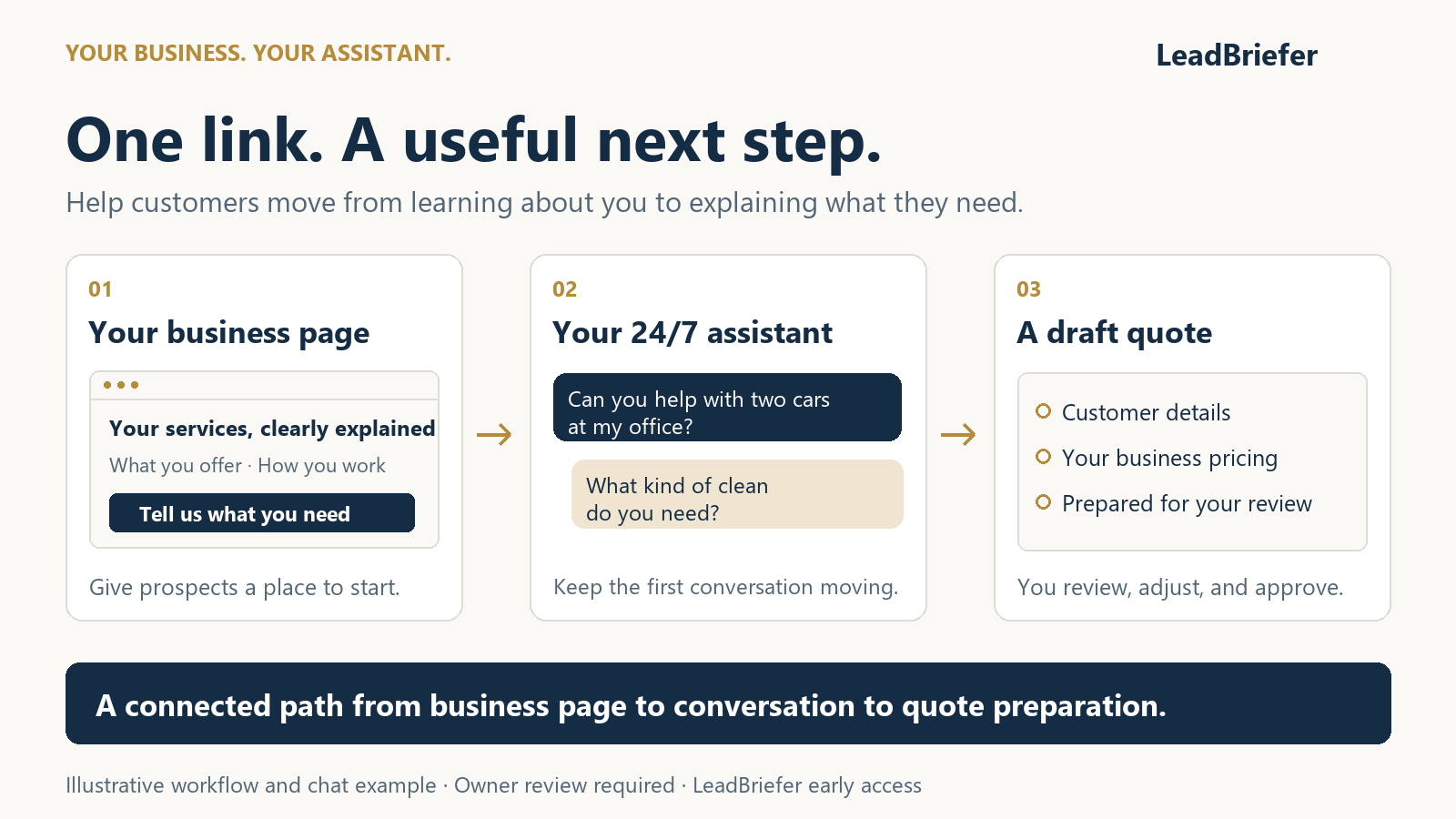
It is 8:30 in the evening. A potential customer wants someone to clean two cars at their office, and they have just found a mobile detailing business online.
They want to know whether the business offers the right service and how to get a quote. The owner has finished work for the day.
A useful business page can give that customer a place to learn about the service and take the next step. With an assistant and quote preparation connected to it, that first visit can also begin the work of understanding the request.
Here is an illustrative look at the experience LeadBriefer is being built to provide.
Give the customer a place to understand your business
Before someone explains a job, they need to understand what you offer.
Your business landing page gives you a destination to share through a social profile, a message, a referral, or your existing website. It introduces your services and gives prospects a clear way to start a conversation with your assistant.
For the mobile detailer, that means the customer can learn about the business before asking about cleaning the two vehicles. For a voiceover studio, the page could introduce recording services. For a pet groomer, it could help someone understand the services available before describing their pet’s needs.
The page and the conversation serve connected purposes: one helps the prospect understand the business; the other helps the business understand the prospect’s request.
Let the first conversation continue after hours
Returning to the detailing example, the customer starts a chat:
Customer: Can you clean two cars at my office?
Assistant: Are you looking for interior cleaning, exterior cleaning, or both?
Customer: Both. One is an SUV and the other is a sedan.
Assistant: What area is the office in?
The customer is already explaining the job while the owner is unavailable.
A 24/7 AI assistant gives customers a way to ask initial questions and share details outside the owner’s working hours. That can be particularly useful when the owner spends the day delivering services, visiting clients, or working to a schedule that differs from the customer’s.
You provide information about your business, including your services, pricing, intake requirements, and what is needed to prepare a quote. LeadBriefer uses that context to determine relevant questions as the conversation develops.
Give the gathered details a useful next step
A conversation becomes more valuable when the information helps move the inquiry forward.
In the detailing example, the number and types of vehicles, the requested service, and the location help define what the customer is asking for. The quoting system behind the conversation can use the request details and the business’s pricing to prepare a draft for the owner.
The owner then reviews the scope, checks the price, makes any adjustments, and approves the quote. Any unresolved point can be clarified before proceeding.
That is the connected workflow: business page, customer conversation, gathered details, draft quote, and owner approval.
Putting the website cost in context
Creating an online presence can involve outside spending as well as your own time.
In its 2026 survey of more than 300 web-development firms across 31 countries, GoodFirms reported that about 60% quoted $1,000–$3,000 for a basic website or MVP. That is a provider-quoted build range; the cost of a particular page or website depends on its scope, features, and how it is built.
A Clutch survey of 406 U.S. small-business owners, conducted in August 2025, found that 45% outsourced their websites to agencies and 9% used freelancers or consultants. Others handled the work internally.
These findings put the setup decision in perspective. A business might commission a site, build one itself, or use a simpler page that meets its immediate needs. Each approach involves decisions about content, design, and how visitors will make an inquiry.
Where a connected experience may reduce costs
For a service business, it is useful to look at the whole path from first visit to prepared quote.
Less separate page setup. If your immediate need is a clear page introducing your services and inviting inquiries, a LeadBriefer business page may reduce the need to commission a separate landing page for that purpose.
Fewer pieces to connect. Building a page, adding an assistant, and arranging a quoting workflow separately can bring setup and ongoing management work. Bringing those functions together can simplify the path you need to put in place.
Less repeated intake and preparation. When the assistant gathers the initial details and helps prepare a draft quote, the owner can spend less time repeating basic questions and assembling the request from separate messages.
Those are potential sources of cost and time savings. The financial result depends on LeadBriefer’s plan, what your business already uses, and which work or tools it actually replaces.
Already have a website? Give inquiries a dedicated destination
Your existing website can continue to introduce your brand, show your work, and support the other things your business needs online.
Your LeadBriefer link can provide a dedicated place for prospects to explain a service request. You can share it from your website or send it directly when someone asks how to get started.
The same idea applies whether you provide work on-site, through remote sessions, as digital deliverables, or through a combination. The assistant starts with your business information and requirements, then helps gather what is needed for a quote.
A customer learns about your services, begins a conversation, and explains the request. You pick it up with more of the preparation already done and a draft you can review.
Give your next inquiry a useful place to start. Join the LeadBriefer early access list for updates on when you can try your business page, 24/7 assistant, and quote preparation workflow.